How Clario technology detects PHI/PII in DICOM images using Amazon Bedrock | Amazon Web Services

Clinical trials represent the bedrock of modern pharmaceutical and medical device development, serving as the empirical mechanism through which life-saving treatments transition from theoretical research to approved therapies. At the heart of contemporary clinical trial execution lies the systematic collection of objective medical data, heavily dominated by advanced imaging modalities such as Magnetic Resonance Imaging (MRI), Computed Tomography (CT), Positron Emission Technology (PET) scans, and X-rays. These diagnostic files—primarily stored and transmitted using the universal Digital Imaging and Communications in Medicine (DICOM) standard—provide critical, quantifiable endpoints that regulators, clinicians, and sponsors rely upon to evaluate therapeutic safety and efficacy.
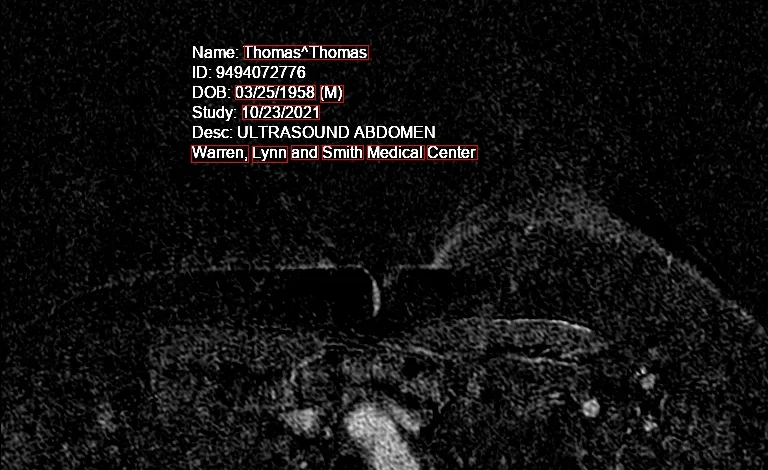
However, the handling of millions of DICOM image slices across globally distributed trial sites introduces a monumental logistical and regulatory hurdle: the rigorous elimination of Protected Health Information (PHI) and Personally Identifiable Information (PII). Patient names, dates of birth, medical record numbers, and facility identifiers are frequently embedded deep within standardized DICOM headers, hidden in vendor-specific private custom tags, or physically burned directly into the image pixels themselves. Failing to eradicate this sensitive data prior to downstream distribution can result in severe breaches of patient privacy, catastrophic regulatory non-compliance, and costly delays in drug approvals.
To eliminate these vulnerabilities, Clario—a premier provider of science and endpoint solutions operating as part of Thermo Fisher Scientific—has engineered a cutting-edge, automated PHI and PII detection pipeline built natively on Amazon Web Services (AWS). Leveraging Amazon Bedrock, Anthropic’s advanced Claude Sonnet 4.5 foundational model, Amazon Textract, and Amazon Elastic Kubernetes Service (Amazon EKS), Clario’s enterprise-grade platform scans 100% of incoming image slices and metadata tags. This sophisticated architecture successfully bridges the gap between massive data scale and absolute regulatory compliance, setting a new benchmark for data security in global clinical research.
The Regulatory Imperative and Operational Complexities of Clinical Trials
For over half a century, Clario’s specialized endpoint solutions have been deployed in more than 30,000 clinical trials. Since 2015 alone, the organization’s meticulous data management protocols have successfully supported over 700 new drug approvals by the United States Food and Drug Administration (FDA) and the European Medicines Agency (EMA). In this high-stakes environment, data integrity and patient confidentiality are not merely operational preferences; they are absolute legal and ethical mandates governed by stringent global frameworks, including the Health Insurance Portability and Accountability Act (HIPAA), the General Data Protection Regulation (GDPR), and International Council for Harmonisation (ICH) E6 Good Clinical Practice (GCP) guidelines.
Traditionally, maintaining compliance required a heavy reliance on manual spot-checks and basic automated scripts to strip identifiable headers from medical images. Yet, modern clinical trials generate staggering volumes of information. A single imaging series can easily comprise thousands of individual image slices, each containing dozens of standard and proprietary metadata attributes. Furthermore, sensitive text is often rendered directly into the visual raster data of the scan, rendering traditional metadata-stripping tools entirely insufficient.

Relying solely on manual oversight for such vast quantities of data introduces significant human error, creates operational bottlenecks, and risks exposing private patient data to third-party sponsors, Contract Research Organizations (CROs), and central laboratories. Recognizing that manual workflows could no longer scale with the accelerating pace of modern drug development, Clario’s engineering and AI teams initiated a comprehensive technological overhaul to modernize their imaging data pipeline.
Architectural Engineering on AWS: Powering Scale and Security
To solve the complex challenge of exhaustive PHI and PII detection across multi-terabyte datasets, Clario collaborated closely with the AWS Solutions Architecture team to design a secure, highly scalable, and auditable cloud-native architecture.
At the ingestion layer, clinical trial sites upload their DICOM image files and PDF documents into Amazon Simple Storage Service (Amazon S3) buckets. Every ingestion event is rigorously logged, ensuring complete metadata traceability across the entire lifecycle of the trial. The processing workflow is securely fronted by Amazon API Gateway, which provides robust endpoint protection via Transport Layer Security (TLS) encryption in transit, Identity and Access Management (IAM)-backed authorization, and strict rate limiting.
Behind API Gateway, Clario’s backend detection engine runs on Amazon Elastic Kubernetes Service (Amazon EKS). Because processing thousands of DICOM slices per series is exceptionally memory-intensive and long-running, containerized microservices orchestrated by EKS dynamically scale to absorb fluctuating workloads without performance degradation. For persistence, the platform utilizes Amazon Relational Database Service (Amazon RDS) running PostgreSQL. This relational database design guarantees strong consistency and supports the complex audit queries mandated by clinical compliance frameworks.
Deep Image Analysis and the Core Detection Pipeline
The technical tour de force of Clario’s solution lies in its multi-layered detection capability, which moves far beyond basic header parsing. The pipeline concurrently analyzes three distinct data surfaces: PDF documentation, standard and custom private DICOM metadata tags, and the raw pixel data of the images themselves.
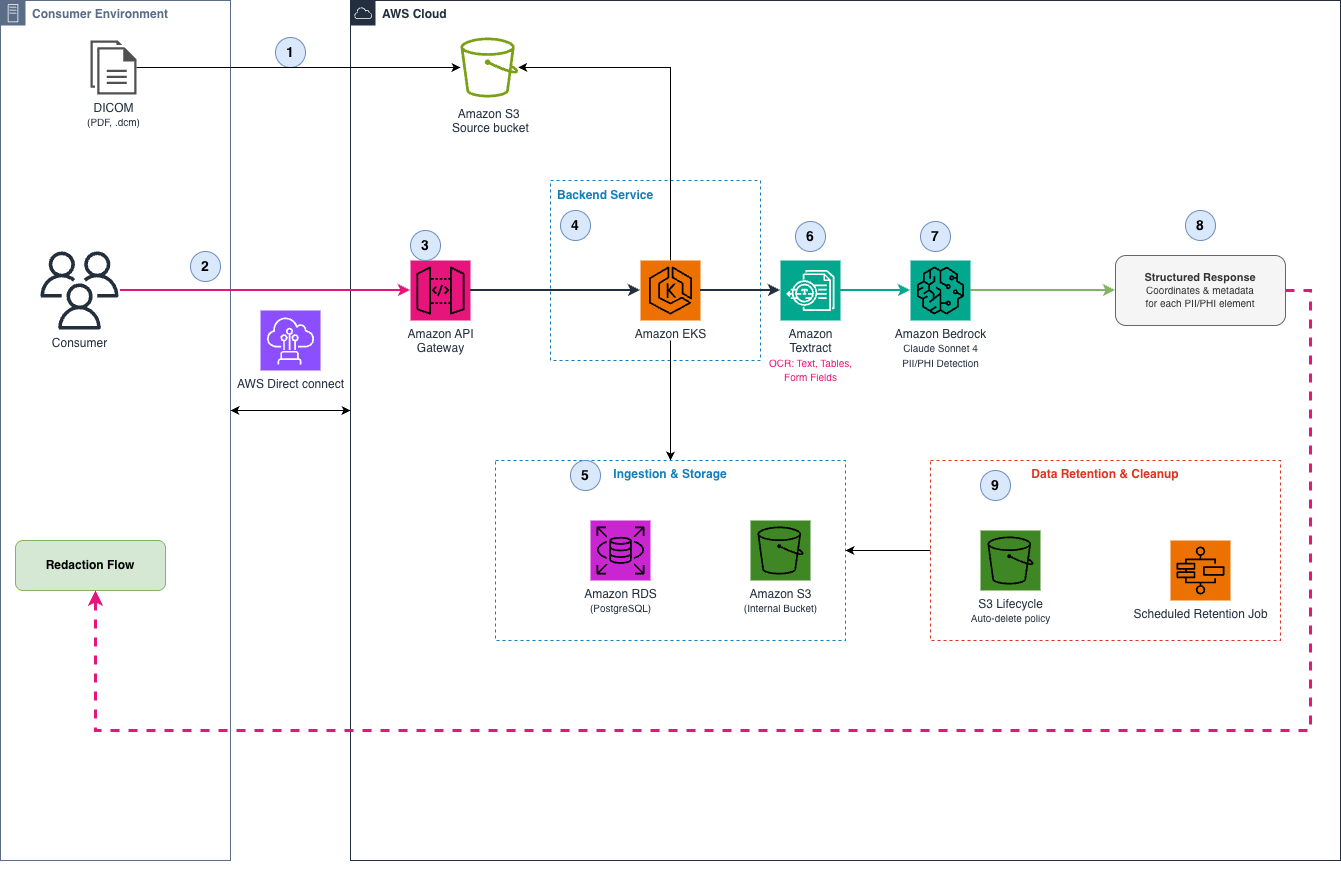
To tackle the formidable challenge of identifying text burned directly into image pixels, Clario integrated Anthropic’s Claude Sonnet 4.5 via Amazon Bedrock, working in tandem with Amazon Textract. Claude Sonnet 4.5 performs a granular, semantic-level scan across every individual image slice in a DICOM series. When the model encounters sensitive data—such as a patient name or identification number subtly embedded within the corner of an X-ray or MRI scan—it captures the precise spatial coordinates and classifies the specific category of PHI.
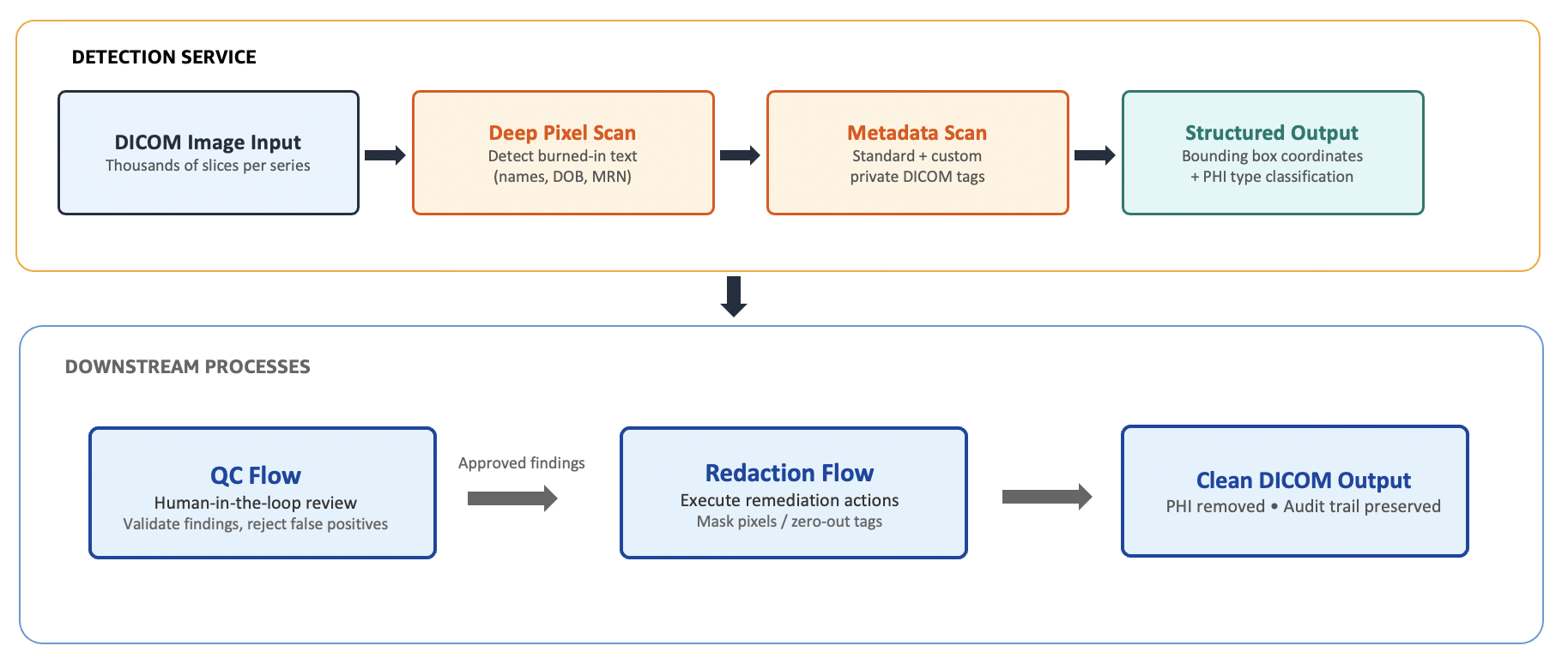
Importantly, Clario’s architecture implements a strict architectural separation between AI-powered detection and actual pixel-level redaction. Rather than allowing automated algorithms to irreversibly alter clinical data, the detection pipeline outputs structured bounding box coordinates and classification tags. These results are then routed into two distinct operational streams:
- The Quality Control (QC) Flow: Qualified human domain experts review the flagged findings within a dedicated quality assurance interface, verifying model accuracy and confirming remediation requirements.
- The Redaction Flow: Once approved, automated or semi-automated systems execute precise corrective actions, such as masking or overwriting burnt-in text within the pixel array, or stripping and zeroing out sensitive DICOM header fields in accordance with DICOM Supplement 142 and National Electrical Manufacturers Association (NEMA) standards.
This deliberate "human-in-the-loop" design ensures that edge cases and model uncertainties are meticulously managed, preserving the absolute scientific and clinical value of the imaging data while eliminating compliance exposure.
Empirical Evaluation and Production Results
Prior to broad commercial deployment, the Clario generative AI team established a rigorous three-stage validation methodology to prove the reliability of the system:
- Representative Dataset Construction: Assembling a diverse test corpus comprising images from various modalities (MRI, CT, PET, X-ray) across multiple clinical sites, featuring both clean files and documents heavily saturated with edge-case PHI.
- Ground Truth Annotation: Generating exhaustive, manually validated "gold standard" labels for every document in the test dataset.
- Automated Evaluation Pipelines: Deploying automated accuracy and latency scripts to benchmark model outputs against the ground truth annotations.
The results of this exhaustive evaluation, measured across three primary detection surfaces, demonstrated exceptional performance:
- PDF Text: Achieved a Detection F1 score of 0.9775, with a label classification accuracy of 98.12%.
- DICOM Burned-In Image Text: Achieved a Detection F1 score of 0.9750, with a label classification accuracy of 96.15%.
- DICOM Metadata Tags: Achieved a near-perfect Detection F1 score of 0.9951, with a label classification accuracy of 99.60%.
These empirical metrics easily cleared Clario’s rigorous production-readiness threshold. By successfully auditing 100% of image slices and metadata fields, the automated system demonstrated a comprehensive detection coverage that effectively supersedes traditional spot-checking methodologies, particularly in uncovering hidden identifiers within non-standard vendor private tags.
Broader Implications for the Healthcare and Life Sciences Industry
The successful deployment of Clario’s PHI detection platform highlights a broader technological and regulatory evolution currently sweeping the life sciences sector. As clinical trials become increasingly decentralized, globalized, and data-intensive, manual compliance mechanisms are rapidly becoming obsolete.
By demonstrating that generative AI foundation models—when paired with enterprise cloud infrastructure and rigorous human oversight—can achieve near-error-free compliance auditing, Clario provides a blueprint for the entire healthcare industry. The architecture effectively resolves a long-standing industry paradox: how to harness the immense analytical power of artificial intelligence without compromising data security, patient privacy, or regulatory compliance.
Furthermore, this collaboration underscores the growing maturity of AWS healthcare solutions. By utilizing Amazon Bedrock and Amazon Textract, organizations can rapidly deploy custom, highly secure AI applications without sacrificing governance or data sovereignty. As regulatory bodies worldwide continue to tighten enforcement surrounding health data privacy, scalable and auditable solutions like Clario’s will transition from competitive advantages to essential operational necessities for all clinical research organizations.
Related posts: